Abdullah Bozkurt/Stockholm
A US federal grand jury has unsealed a sweeping indictment alleging that a Turkish construction contractor and a senior NATO official operated a covert bribery and fraud scheme for nearly a decade, corrupting NATO procurement processes to secure lucrative military construction contracts funded in part by American taxpayers.
The indictment, filed in the US District Court for the District of Columbia, charges Bahadır Hatipoğlu, a Turkish national, and Ralf Grynow, a German national who served in senior roles in NATO and its procurement structures, with conspiracy to commit wire fraud, wire fraud, honest-services fraud, aiding and abetting and criminal forfeiture.US District Court for the District of Columbia, charges Bahadır Hatipoğlu
Prosecutors say the scheme ran from at least June 2014 through December 2022 and targeted NATO-funded construction projects linked to the US Army Corps of Engineers and the Defense Logistics Agency, two key US military bodies responsible for infrastructure and logistical support worldwide.
Corporate records, obtained by Nordic Monitor, show that Hatipoğlu established his main Turkish company, Hatcon İnşaat Taahhüt İthalat İhracat Limited Şirketi, in Ankara in June 2014 — the same month US prosecutors say the criminal conspiracy began. The timing is striking.
According to the indictment Hatipoğlu was already cultivating an illicit relationship with Grynow as Hatcon was coming into existence, suggesting the company may have been created specifically to exploit access to NATO procurement channels.
The full text of the US indictment against Bahadır Hatipoğlu:
Prosecutors describe Hatipoğlu as the owner and general manager of the construction company that ultimately benefited from the corrupt arrangement, winning NATO, USACE and DLA-linked projects over the following years.
The company’s website, defunct now, but accessible through the Wayback machine, shows that Hatcon in Turkey was actually an offshoot of HAT Construction FZE, a company that was established in the United Arab Emirates in 2012 and active in both the UAE and Afghanistan.
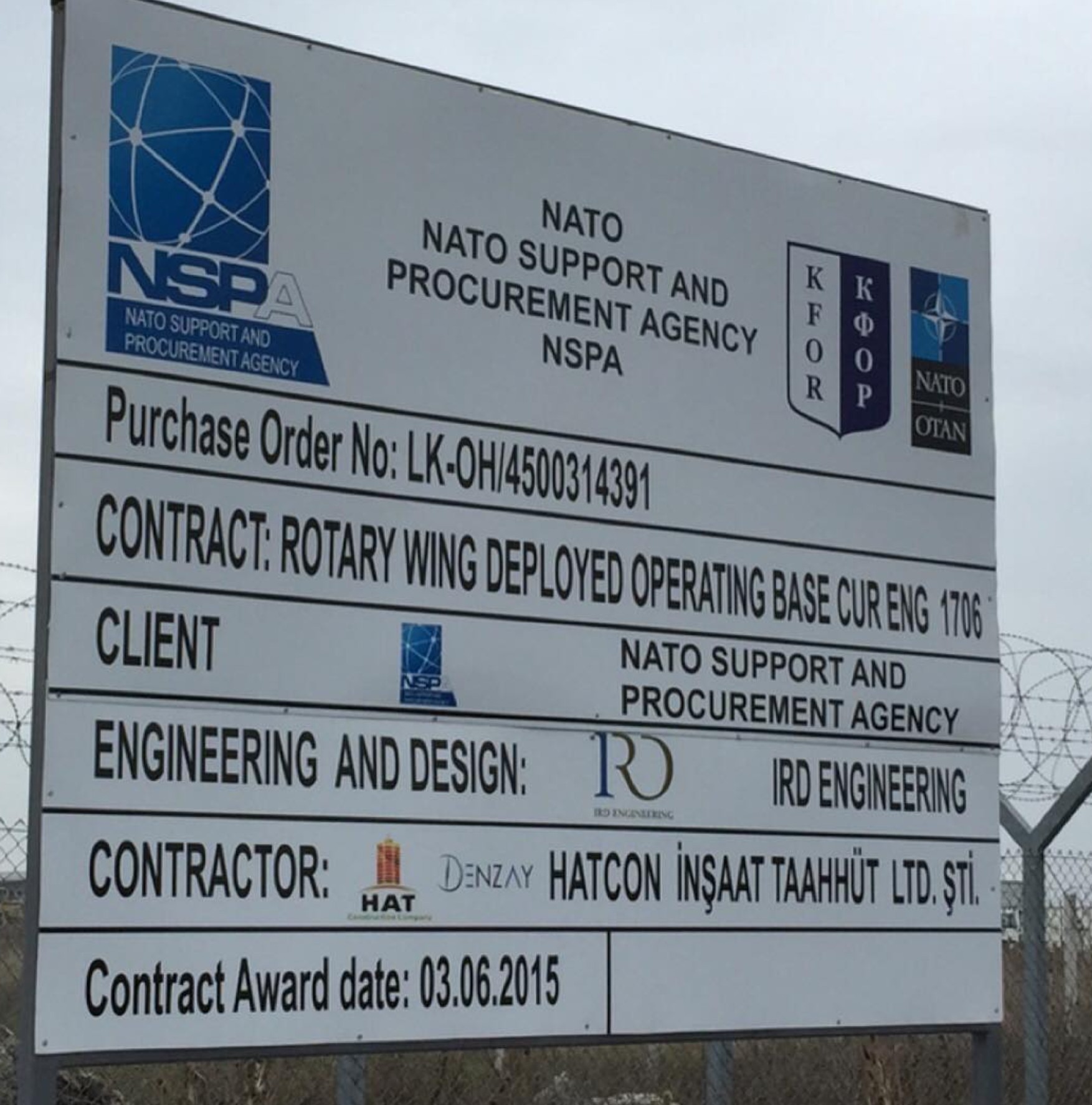
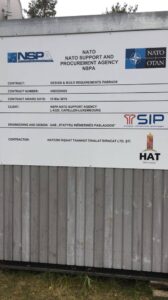
The company publicly showcased projects directly linked to US and NATO military infrastructure, including fuel storage and distribution facilities for the US Army in Afghanistan, helipads, airfields and hangars for NATO and KFOR forces in Kosovo, and rotary-wing operating bases. These projects were presented as references demonstrating experience with Western military clients.
Independent procurement records confirm that Hatcon was registered in US federal contracting systems and was awarded US Army Corps of Engineers contracts in Europe, including projects in Poland, Lithuania and Latvia.
In addition to the Ankara-based company, Hatipoğlu has also registered a similar construction firm in Lithuania. While the US indictment does not name the Lithuanian entity, the existence of an EU-registered counterpart highlights the cross-border corporate structure that enabled Hatipoğlu to operate across multiple jurisdictions while bidding on Western-funded military construction projects. Such structures are frequently used by Turkish contractors seeking easier access to European markets and NATO-related tenders.

At the heart of the scheme, according to prosecutors, was Grynow’s abuse of his position within the NATO Support and Procurement Agency. Over the years Grynow held a series of sensitive posts, including civil engineer, infrastructure support specialist, senior technical officer and NATO infrastructure advisor. These roles gave him significant influence over the selection, evaluation and oversight of contractors competing for NATO projects.
As a NATO official, he was bound by strict ethical rules prohibiting the acceptance of gifts or payments from contractors and was required to safeguard confidential procurement information. The indictment alleges he repeatedly violated these obligations by secretly partnering with Hatipoğlu and steering contracts toward Hatcon and its affiliated entities.
The bribery scheme, as described in the charging document, relied on a steady flow of cash, luxury benefits and personal favors. Hatipoğlu allegedly paid Grynow in cash, supplied gold and jewelry, financed luxury travel and covered personal expenses benefiting Grynow and those close to him.
The trade registry record shows that Hatcon was established in Ankara in 2014:
In one instance in 2015 Grynow allegedly received €1,000 in cash delivered in an envelope at a hotel restaurant in Dubai, coordinated through WhatsApp messages exchanged among Grynow, Hatipoğlu and an intermediary. In other episodes Hatipoğlu is accused of arranging and paying for romantic encounters for Grynow in Dubai, communicating directly with women on Grynow’s behalf and booking hotel rooms under Grynow’s name, all while using encrypted messaging to conceal the activity.
The benefits escalated in later years. Between 2018 and 2020, Grynow allegedly solicited and received payments from Hatipoğlu to finance construction and renovation projects in Poland, including work linked to Grynow and one of his romantic partners. Additional funds were wired directly to the bank accounts of Grynow’s partners, with Hatipoğlu executing the transfers after receiving screenshots of account details via WhatsApp. Prosecutors say these payments were designed to enrich Grynow personally while ensuring his continued cooperation inside NATO.
In return Grynow allegedly manipulated NATO’s contractor evaluation system to Hatipoğlu’s advantage. Central to the fraud were past-performance questionnaires, standardized evaluation forms used by NATO, USACE and the DLA to determine whether contractors should be awarded future projects. These forms were meant to be completed independently and to disclose any violations, including bribery or conflicts of interest.

Instead, prosecutors allege that Grynow signed questionnaires that had been pre-filled by Hatipoğlu’s company, falsely certified compliance with NATO’s anti-bribery rules, omitted any reference to kickbacks and conflicts and issued glowing endorsements that helped Hatcon and related entities secure additional contracts. In several instances Grynow allegedly stamped the documents with official NATO and NSPA seals and transmitted them through email servers located in the United States, triggering US wire-fraud jurisdiction.
The indictment further alleges that Grynow leaked confidential NATO procurement information to Hatipoğlu, including advance details about upcoming projects, internal evaluations and bid specifications. This information reportedly covered multiple NATO-funded construction projects in Afghanistan, ranging from fuel storage facilities and firefighting infrastructure to water and sewage systems, power-generation projects and training facilities.
Grynow also allegedly participated in overseeing and approving invoices submitted by Hatipoğlu’s company after contracts were awarded, deepening the conflict of interest and further embedding himself in the scheme.
To avoid detection the defendants allegedly took deliberate steps to conceal their communications. They avoided official NATO email systems and relied instead on personal email accounts and WhatsApp, whose end-to-end encryption made oversight more difficult. At one point Grynow explicitly warned Hatipoğlu not to use business email accounts, advising that sensitive communications be kept away from NATO monitoring mechanisms.
Although neither Hatipoğlu nor Grynow resides in the United States, prosecutors say the case properly belongs in federal court in Washington because the scheme relied on US-based wire communications, including emails and electronic submissions routed through American servers and sent to US military agencies.
The United States is also a major financial contributor to NATO, meaning US taxpayer funds were directly exposed to fraud. Prosecutors argue that American agencies were deprived of honest services and fair competition when corrupt evaluations influenced how military construction contracts were awarded.
If convicted, Hatipoğlu and Grynow face the prospect of lengthy prison sentences, substantial financial penalties and the forfeiture of assets linked to the bribery scheme. Beyond the courtroom, the case exposes serious weaknesses in NATO procurement oversight and raises broader questions about how contractors operating through Turkish and EU-registered entities were able to exploit insider access to one of the world’s most powerful military alliances for years without detection.
This is not the first time a Turkish military contractor has been indicted by US authorities over alleged corruption tied to NATO projects. In a previous high-profile case reported by Nordic Monitor, US prosecutors charged a Turkish defense contractor and a former NATO official with bribery and fraud for manipulating NATO procurement processes to secure lucrative contracts.
That case, however, ended abruptly. In July 2025 the US Department of Justice quietly dropped all charges without providing a public explanation, despite detailed allegations and supporting evidence. The decision came just days after a summit between US President Donald Trump and Turkish President Recep Tayyip Erdoğan, raising questions about political and diplomatic considerations overriding law-enforcement priorities.
The case followed a familiar pattern: a Turkish contractor leveraging insider access within NATO, falsified evaluations and corrupt relationships to penetrate Western military procurement systems. Although the defendant walked free, the case exposed systemic vulnerabilities in NATO contracting and highlighted how Turkish companies operating in sensitive defense sectors have repeatedly drawn scrutiny from US investigators.
Against this backdrop, the indictment of Bahadır Hatipoğlu marks a recurring enforcement theme rather than an isolated incident, underscoring persistent concerns within US law-enforcement circles about corruption risks involving Turkish contractors embedded in NATO and US military supply chains.