Abdullah Bozkurt/Stockholm
A new series of mafia shootings in Turkey has revived concerns that fugitive crime boss Sedat Peker, a convicted felon who once allied himself with President Recep Tayyip Erdogan to target the Turkish leader’s opponents and critics, continues to exert coercive power inside the country from a safe haven in the United Arab Emirates.
Peker, who is wanted by Turkish authorities on multiple criminal charges and is subject to outstanding arrest warrants disseminated through INTERPOL, has neither been arrested by Emirati authorities nor extradited to Turkey to face trial. Operating from abroad, he continues to direct his underworld network, targeting opponents in turf feuds and punishing those who cross him while generating illegal revenue that helps sustain his lavish lifestyle in Dubai.
The latest incident involved Süleyman Yasin Akdeniz, a small-time criminal known by the nickname “Hacı,” who was shot in both legs in Gölcük in September 2025. Akdeniz was hospitalized with gunshot wounds in what sources described as a deliberate warning-style attack. He had fallen out with his former patron Peker, taken an adversarial stance and repeatedly published images of handwritten letters attributed to Peker, causing public embarrassment and reputational damage.
The attack follows a pattern long associated with Peker’s underworld methods, commonly described by insiders as punishment meted out from what he calls his “kara kaplı defter,” or black ledger — a list of individuals he allegedly targets after falling out with them following his flight abroad. People familiar with the dispute say Akdeniz’s disclosures and taunts placed him squarely on Peker’s blacklist, triggering retaliation intended to deter others from resurfacing sensitive material from Peker’s past.
The Gölcük shooting is the latest in a string of violent incidents in which Peker is alleged to have orchestrated attacks through loyal operatives still active in Turkey. To date roughly a dozen incidents — including two killings — have reportedly been linked to a revenge campaign pursued by Peker as he seeks to reassert his position in the underworld after being weakened by law-enforcement actions.
Leg-shootings are a method widely used in Turkey’s criminal milieu to punish and intimidate without immediately triggering the political and legal consequences of murder. Victims have included journalists, former associates and rival figures who clashed with Peker or his circle, reinforcing the perception that even from abroad, Peker’s name continues to function as a threat multiplier in Turkey’s shadowy power struggles, where the mafia world is closely intertwined with political conflict.
Peker twice targeted his longtime rival, underworld figure Semih Tufan Gülaltay, who regularly posts videos attacking him. Gülaltay’s office was sprayed with gunfire in May 2022 in an incident that left one man dead. A year later Gülaltay faced a second shooting outside his home. The May 2023 attempted assassination of Ali Uğur Uzun, described as a powerful but low-profile figure linked to the Sarallar criminal network, was also attributed to Peker, who allegedly contracted a new-generation crime boss, Barış Boyun — currently jailed in Italy — to carry out the hit.
Two brothers, Cenk Çelik and Zafer Çelik, became prominent targets after posting repeated videos attacking Peker following his departure from Turkey. Cenk Çelik was shot in Ümraniye with intent to kill in September 2022 and later died from his wounds. His brother Zafer Çelik abruptly fell silent and stopped publishing content. Güniz Akkuş, described as a rare female figure in underworld circles who had publicly threatened Peker, was later shot in the legs on June 4, 2024.
Emre Erciş, described as a Turkish government intelligence asset embedded in media circles under the cover of journalism, was shot in the leg by two motorcyclists after publishing content that included remarks about Peker’s wife.
Cengiz Şıkkaroğlu, known as Çerkez Cengiz, another underworld figure who made provocative remarks about Peker, was shot in the leg in December 2022 and later faded from the scene. Oğuz Bulut, Peker’s former associate who spent prison time with him and later became a liability, was shot in the leg after previously going to the police to claim he feared Peker. Another target was İrfan Aydın, a local newspaper owner and YouTuber who attacked Peker online before being shot in the legs and forced into silence.
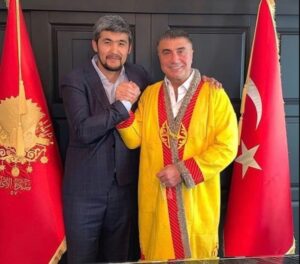
Turkey transmitted two separate extradition files for Peker prepared by chief public prosecutors’ offices to Emirati authorities in May 2021, citing alleged crimes including forming a criminal organization, armed robbery and looting by exploiting the intimidating power of a criminal organization and related offenses. Turkish officials also sought an INTERPOL Red Notice for Peker, which the organization’s General Secretariat issued on February 1, 2022.
Turkish authorities confirmed that the extradition request was raised again during Justice Minister Yılmaz Tunç’s official visit to the UAE on December 4–5, 2024, adding that the case continues to be followed by the Justice Ministry and Turkey’s embassy in Abu Dhabi.
Peker emerged as a powerful mafia boss in the 1990s and later built extensive alliances with political actors, particularly within the Justice and Development Party (AKP) and its ultranationalist ally, the Nationalist Movement Party (MHP). His long criminal record — including convictions and repeated arrests for racketeering, organized crime, kidnapping and violence — did not prevent his rise as long as he deployed his criminal enterprise in the service of the Erdogan government’s political goals.
In the 2010s Peker frequently issued public threats against academics and intellectuals who supported peaceful resolution of the Kurdish issue in Turkey, warning that he would “spill your blood in streams and bathe in it” after more than a thousand academics signed a petition calling for an end to violence in the predominantly Kurdish southeast.
Peker also directed violent rhetoric toward members of the Gülen movement, a faith-based network inspired by the late Turkish Muslim scholar Fethullah Gülen that became a central critic of President Erdogan. He threatened movement members with extreme violence, including statements that they would be hanged from flagpoles and trees and declared that detained followers would be killed.

Over time, Peker grew more ambitious and struck deals with some government officials, particularly then–interior minister Süleyman Soylu, to position himself as the dominant mafia figure in a post-Erdogan era. When Erdogan sidelined Peker’s political patrons who had shielded him from legal trouble, Peker was left without protection and forced to flee first to the Balkans around 2019, then to Africa and ultimately to Dubai, where he attracted global attention by publishing YouTube videos alleging corruption, criminal collusion and abuse of power by senior politicians and state officials.
Peker’s disclosures were shaped largely by his own underworld feuds and survival calculations. He was eventually forced into silence — reportedly under pressure from Emirati authorities or, according to some accounts, after receiving a substantial hush payment from Turkish intermediaries. His silence, however, did not end his criminal operations. He is alleged to have continued running his organization, laundering illegal proceeds and financing a lavish lifestyle in the UAE.
Criminal cases against Peker in Turkey remain pending, and Ankara continues to press Emirati authorities to surrender him for trial. Yet despite these formal steps, Peker has remained beyond the reach of Turkish law enforcement since 2021.
The resurfacing of violence linked to personal vendettas reinforces the reality that Peker remains a seasoned crime boss whose power base rests on coercion, fear and the maintenance of reputational dominance in criminal networks. His ability to direct violence from exile continues to destabilize Turkey’s domestic arena, undermine law and order and erode public security. For Turkish authorities, the persistence of such attacks despite extradition requests and an INTERPOL Red Notice underscores the limits of legal instruments when confronted with transnational safe havens and deeply entrenched criminal–political entanglements at home.