Abdullah Bozkurt/Stockholm
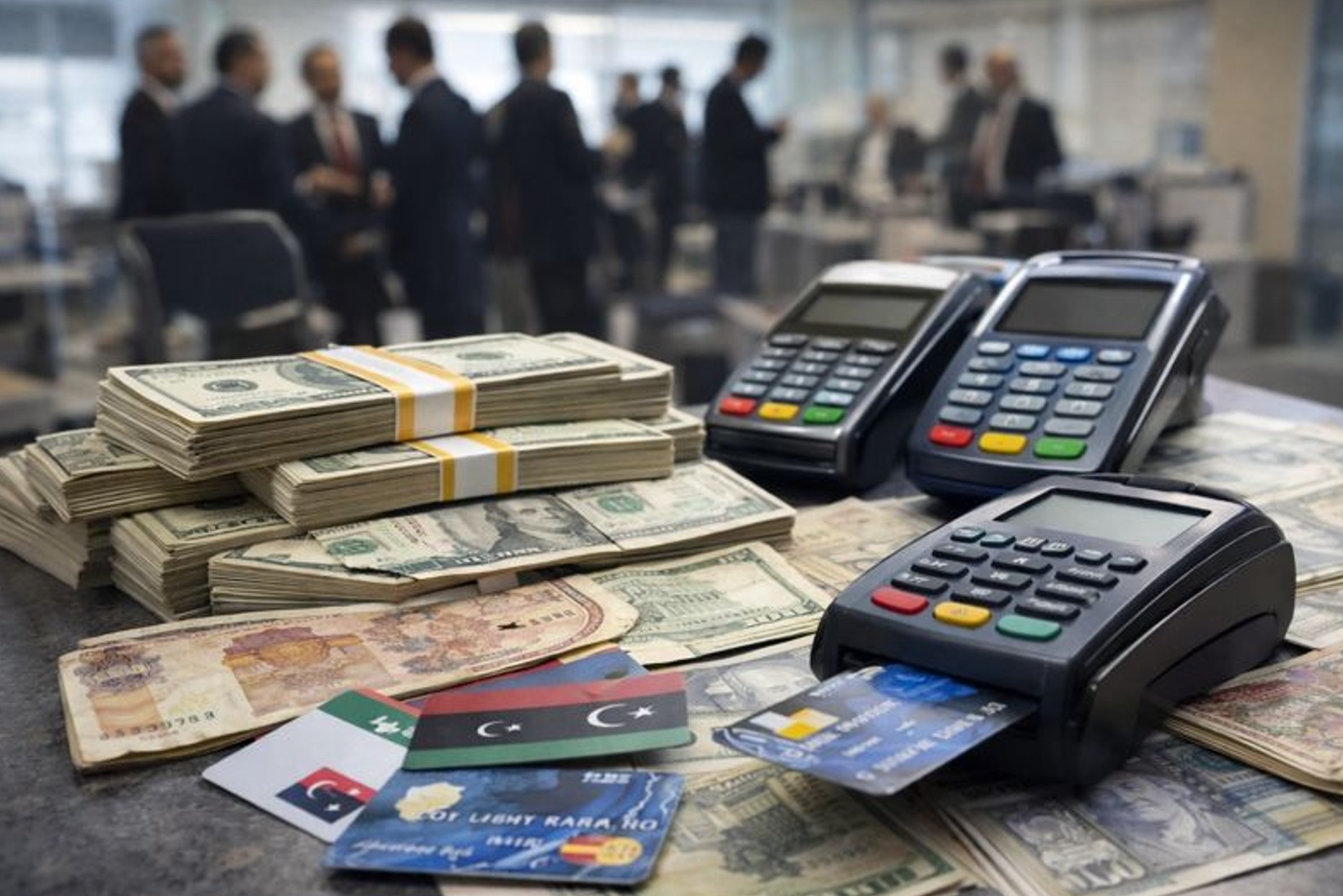
Forced to launch an investigation into a money-laundering ring tied to Libya under mounting international pressure, Turkish authorities have nevertheless managed to limit both the scope and depth of the criminal probe into what is believed to involve more than $100 billion in illegal funds, critics say, shielding the real masterminds of the scheme as well as regulators and senior banking figures who allegedly turned a blind eye to vast, suspicious credit-card transactions.
The warning comes from Özgür Karabat, deputy chair of Turkey’s main opposition Republican People’s Party (CHP), who has accused prosecutors and financial regulators of deliberately narrowing an investigation that he says exposes one of the largest organized money-laundering operations in Turkey’s modern history. In a series of statements on social media platform X, Karabat argued that the officially disclosed figures — tens of billions of lira processed through point-of-sale (POS) devices — represent only a fraction of the real scale of the operation.
According to Karabat, the laundering scheme did not begin in 2022, as stated by prosecutors, but as early as 2019, and the bulk of the transactions were conducted in US dollars, later recorded in Turkish lira to obscure their true magnitude. “The real transaction volume is far above 47.5 billion lira,” he said. “When calculated correctly, this system exceeds $120 billion.”
Karabat also criticized what he described as selective enforcement. While the investigation has so far focused on a limited number of banks — most notably Denizbank and Şekerbank — and resulted in the detention of lower and mid-level employees, he said senior executives who allegedly designed and authorized the POS-based system have been left untouched. “Everyone in the banking sector knows who set up and ran this system,” he said. “Why are they being protected?”
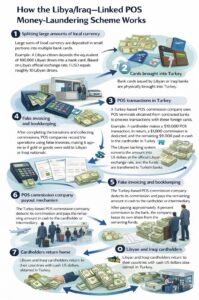
The scheme involved a major fraud, in which banks, fintech companies, bureaucrats and politicians played coordinated roles as part of an organized system. However, the key actors at the heart of the operation remain untouched.
At the center of the case is Istanbul’s Laleli district, a long-established hub for gold trading, currency exchange offices and the so-called “suitcase trade.” Prosecutors allege that a network of jewellers, foreign-exchange houses and front companies used hundreds of POS terminals to launder funds under the guise of legitimate trade, primarily fictitious gold sales and exports to Libya and, to a lesser extent, Iraq.
According to the Istanbul Chief Public Prosecutor’s Office, between 2022 and 2024 at least 21 companies used 312 POS devices to process more than 47.5 billion Turkish lira in suspicious transactions. Arrest warrants were issued for 85 suspects, and dozens of companies and payment institutions were placed under seizure or trusteeship.
Regulatory reports included in the case file paint a picture of industrial-scale abuse. Turkey’s banking watchdog BDDK found that the POS terminals processed tens of billions of lira with no credible link to real goods or services.
The Financial Crimes Investigation Board (MASAK) reported that the devices were sourced from 15 different banks and payment institutions and flagged extreme anomalies in transaction timing and volume.
One MASAK analysis shows that 8.4 billion lira worth of card transactions were carried out between 10 p.m. and 8 a.m., a pattern investigators say is incompatible with normal retail activity. In a single night more than 95,000 transactions were recorded, almost all using foreign-issued cards.
In total state experts have examined 921 POS devices, 110 bank accounts and the financial records of 86 companies, reviewing transactions worth 112.2 billion lira for the 2020–2023 period alone. A MASAK report dated October 2025 concluded that 99.99 percent of the flagged POS transactions were conducted with foreign cards, primarily issued in Libya, Nigeria and Iraq.
Company-level data included in the investigation reveal stark discrepancies between recorded bank flows and POS turnover.
In one case a gold-trading company linked to the suspects recorded only a few hundred million lira in bank inflows and outflows over several years, while POS transactions associated with the same company exceeded 8 billion lira. Prosecutors estimate that at least 165 million lira in criminal profit was generated through this mechanism alone.
Another Laleli-based gold company processed more than 4.5 billion lira in POS transactions in just two years. To satisfy compliance checks, the firm reportedly submitted 472 foreign passports said to belong to cardholders. Subsequent forensic analysis found that nearly all of these passports were either fake or belonged to individuals who had never entered Turkey.
Investigators say such patterns — explosive spikes in turnover, identical transaction amounts repeated hundreds of times and rapid cash withdrawals immediately after POS settlements — are “contrary to the ordinary course of economic life.”
The Libyan dimension of the case is central. According to secret witness testimony in the file, hundreds of POS terminals supplied by Turkish banks were physically shipped to Libya, while boxes of Libyan bank and credit cards were transported to Turkey. On paper the terminals recorded sales of gold or goods to Libyan customers. In reality, no merchandise changed hands.
Libya’s economic structure made the scheme particularly lucrative. Libyan citizens receive regular payments into their bank accounts from oil revenue and, during periods of instability, were permitted to use their cards abroad. The gap between Libya’s fixed exchange-rate system and Turkey’s floating lira created an arbitrage opportunity that the network exploited at scale. Cardholders allegedly received small commissions, around 2 percent, for allowing their cards to be used.
Video footage included in the investigation shows rows of POS terminals and stacks of cards being used in rapid succession, with operators processing hundreds of transactions within hours. In one documented instance, a single POS device linked to a small Laleli company processed hundreds of transactions in less than three hours, all on different Libyan cards but for nearly identical amounts.
The case began with a whistleblower complaint filed in 2022 with prosecutors in Istanbul’s Küçükçekmece district, alleging large-scale money laundering through POS and electronic payment systems disguised as export activity. Critics say Turkish regulators were aware of the scheme well before that but failed to act. When enforcement finally began in July 2025, the subsequent crackdown was limited in scope, focusing on selected businesses while leaving the broader system largely untouched.
In an official statement prosecutors said 16 employees of banks and payment companies were among those targeted. Yet Karabat and other critics argue that the investigation has been deliberately contained to avoid implicating senior figures and regulators.
The scandal has broader international implications. Libyan authorities claim that more than $20 billion in state-linked funds have been siphoned out of the country through similar schemes.
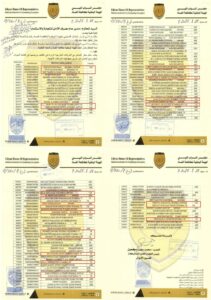
A confidential list circulated in January 2025 by the Libya House of Representatives Anti-Corruption National Commission accused dozens of companies of money laundering via POS transactions and urged that their operations be banned and terminals shut down. The document, sent to Aman Bank, comes amid claims that more than $20 billion in Libyan reserves were siphoned abroad through illegal channels.
According to the report most of the listed firms are based in Turkey and Dubai, with 24 companies operating in Istanbul’s Laleli and the Grand Bazaar districts; many Dubai entities are said to have Turkish links. The commission alleged that purported POS-based trade with Libya never actually occurred and that funds were instead channeled to Laleli-centered companies in Turkey on a false commercial pretext.
The scheme is said to have begun around 2018 and accelerated during the pandemic, with business groups including Dağlar Group, HKN Enez Group Kuyumculuk, Boz Turizm, ACR Group and Akkayalar İç ve Dış Ticaret flagged in the report.
Since the alleged laundering relied on the international banking system and may have violated sanctions on Libyan assets, the case has attracted the attention of US and UN authorities. Karabat claims Washington has long been aware of the POS-based flows.
Turkey’s position on the Financial Action Task Force (FATF) grey list added to the pressure. In 2021 FATF put Turkey on its “grey list” for deficiencies in combating money laundering and terror financing, underscoring systemic vulnerabilities. Although Turkey was removed from the list in 2024, FATF issued a series of warnings that Ankara still had significant work to do to clean up its financial system.
In April 2025 MASAK publicly responded to criticism of the abuse of the POS system, saying that it has tightened controls on POS devices to prevent their use in money laundering, citing regulatory changes published on December 25, 2024, that impose stricter identity checks and usage limits on payment and electronic money institutions. MASAK said certain payment instruments are now restricted to physical card-present transactions or certified websites and that additional control obligations have been imposed to prevent misuse outside permitted purposes.
The agency also said it had identified POS devices heavily used with foreign-issued cards and the financial institutions that facilitated their provision, and that those terminals were subsequently shut down. MASAK added that it coordinated with international card networks to conduct detailed reviews of the nature and purpose of the transactions. However, the agency did not explain why it waited years before acting on activity of such a scale, patterns that experts say would normally trigger early red flags within the banking system.
Karabat warns that unless the investigation is expanded and conducted transparently, Turkey risks facing an international crisis reminiscent of the Halkbank sanctions case, in which President Recep Tayyip Erdogan and his close business and political associates were implicated in a sanctions-busting scheme involving billions of dollars in Iranian funds. “This cannot be covered up,” he said. “Protecting those who launder money and evade taxes will only deepen the damage. The public’s money must be recovered.”
One of the companies targeted in the investigation is Ozan Elektronik Para A.Ş., run by Ozan Özerk who was mentioned in the Offshore Leaks documents as having links to a network spanning the UK, Norway, Malta, Cyprus and Turkey and is alleged to have been associated with Halil Falyalı, a US-indicted drug trafficker. Despite this background, Özerk was able to settle in Turkey, establish a fintech company and obtain all the required licenses, raising serious questions about regulatory oversight.
Reports prepared by MASAK, the Central Bank of the Republic of Turkey and independent auditors found that high-value, repeated card transactions, often originating from countries such as Libya and Iraq, were allowed to pass via virtual POS terminals, despite alarms being triggered. The patterns indicated fund transfers rather than genuine commercial transactions.
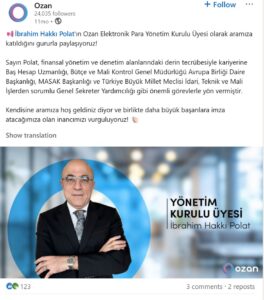
Two board members who served at Ozan’s company have notable political and bureaucratic backgrounds. Ömer Duman previously held several senior posts, ranging from positions at the Finance Ministry to membership on the Turkish central bank’s Monetary Policy Committee, and ran on President Erdogan’s ruling AKP ticket for a parliamentary seat in 2015. İbrahim Hakkı Polat, another board member, served in key positions including head of MASAK and the EU department chief at the Finance Ministry’s Budget and Financial Control Directorate.
In October police raids authorities cracked down on companies including theDağ Group, Kaya Gold, Kaya Altın Değerli Madenler AŞ, Laleli Altın Ticareti, Aklar Döviz, Cengizler Döviz, Taç Döviz and the Marsoy Group, detaining 59 people. No action was taken against political associates or the banks that enabled the use of POS terminals for illicit funding flows from Libya, according to the investigation.
For now, courts have ordered the continued detention of dozens of suspects, while prosecutors say the investigation is ongoing. Whether it will reach the senior figures and institutions critics accuse of enabling the scheme or remain confined to its current boundaries may determine whether the Laleli POS scandal becomes a domestic embarrassment or a full-blown international reckoning.