Levent Kenez/Stockholm
Turkey is facing a growing problem as officials and civil society groups report a link between online gambling and suicides in the Turkish Armed Forces. Concerns about the role of virtual betting in the death of service members are becoming more difficult for authorities to dismiss.
The debate escalated on November 26, 2025, when Defense Minister Yaşar Güler appeared before parliament’s Planning and Budget Committee. Speaking unusually directly, Güler said recent suicide investigations revealed a clear pattern: Many of the young conscripts and officers who died had been drawn into online betting, lost money and found themselves trapped in debt. He described virtual gambling as one of the strongest factors driving self-harm in the military today.
Each case is reviewed through strict procedures, Güler noted, yet the same disturbing signs keep appearing: betting accounts deposits and withdrawals and digital traces pointing to a growing addiction quietly spreading through young recruits. What once seemed like an individual issue now looks like a systemic one.
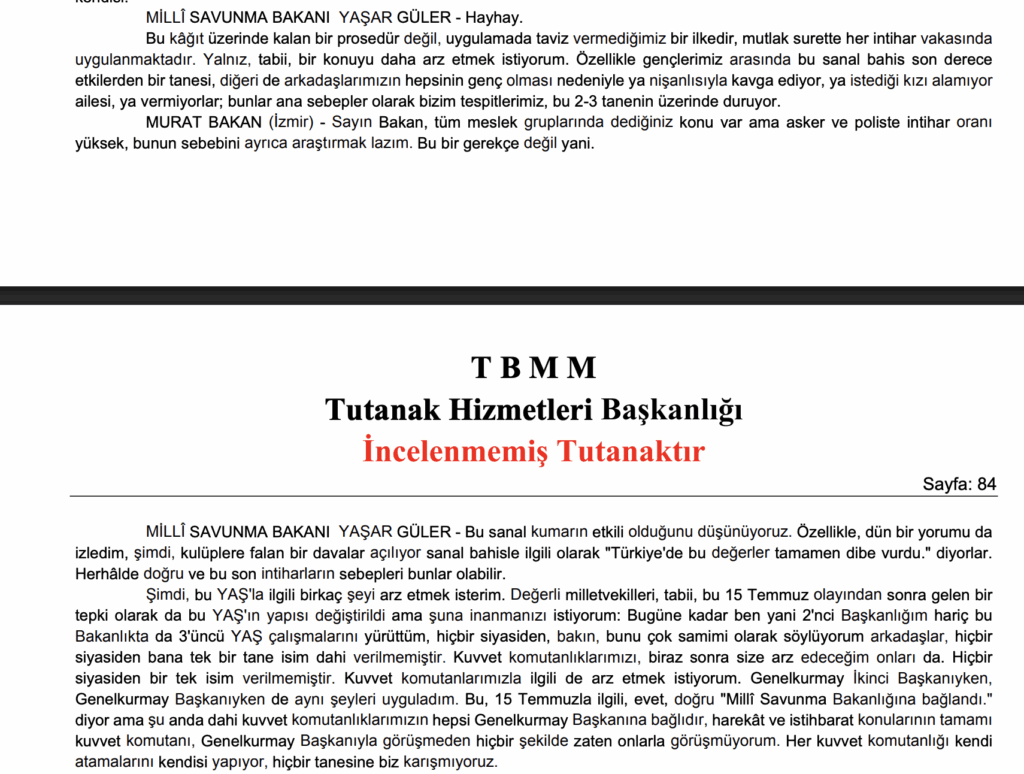
Suicides and suspicious deaths in the armed forces are not new. For years there have been claims that some training-related fatalities were recorded as suicides and that cases involving alleged mistreatment by commanders were also classified in the same way. The military has not regularly released suicide-related data for a long time, which has made independent assessment difficult. An older statistic cited during a recent parliamentary committee meeting showed the scale of the issue. According to that figure 934 members of the armed forces had died by suicide, while 818 had been killed in cross-border operations or terrorist attacks.
The minister’s remarks indicate that suicides linked to legal and illegal betting and gambling are now emerging inside the armed forces and that the issue is no longer being kept out of public view. Even so, it’s unclear whether gambling is the primary cause in each case or whether it is being used as an official explanation for more complex circumstances. Verification is difficult given the limited transparency surrounding military deaths.
Still, similar patterns in other security institutions suggest the possibility is real. Suicide cases in the police force have also risen, and several notes left behind by officers have referred to gambling debts and financial pressure. Last year 74 police officers took their own lives, a number attributed largely to economic hardship and depression. During the first eight months of 2025 the figure reached 66, pointing to a continuing trend that analysts say could be reflected within the military as well.
Beyond the barracks a larger picture emerges. Illegal online gambling has ballooned into a shadow economy. Financial crime units warn that illicit betting platforms have become a preferred channel for laundering money. Investigations show transactions routed through shell companies, payment intermediaries and compromised financial services, often at volumes that dwarf many legal businesses.

The issue came into sharper focus when authorities seized the IQ Money payment company after discovering it had processed billions of lira in suspicious transfers tied to gambling sites even though its license had been revoked the previous year. Officials said the company simply shifted to alternative channels and kept operating for illegal networks. Yet many of these financial companies continue to operate despite the crackdown
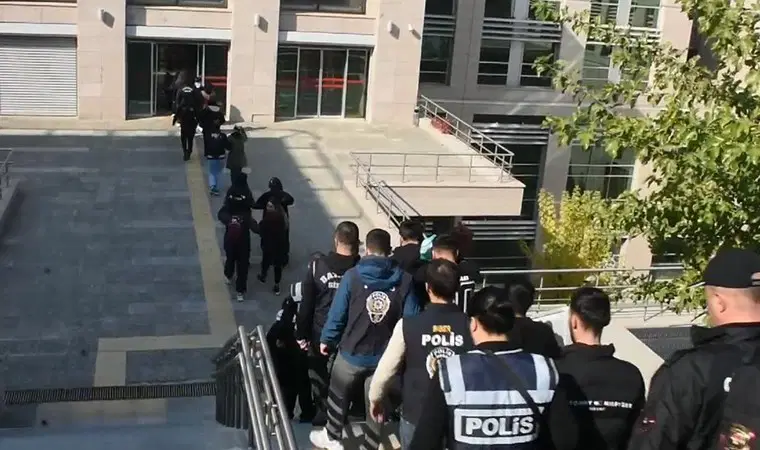
Police operations across the country have led to hundreds of detentions over the past two years. Investigators describe these networks as highly organized, relying heavily on young people whose bank accounts are used to move funds. Many of them — students, underpaid workers or the unemployed — are recruited with simple promises of quick cash and often have little understanding of the scale of the activity conducted in their name.
On the ground civil society groups say the crisis is even deeper than the numbers show. Yunus Çetinkol, who runs a youth support association, says eight out of 10 teenagers he encounters either gamble online or have a close family member who does. He points to the role of influencers who present luxury lifestyles and promise effortless earnings via betting channels, drawing in adolescents who feel they have little to lose.
Criminal groups have also shifted their attention. According to Çetinkol gangs realized that online betting offers lower risk and higher profit than drug sales. Many individuals previously prosecuted for narcotics offenses moved into gambling during and after the pandemic, taking advantage of anonymity and the lack of territorial conflict.
The pandemic itself accelerated these trends. Lockdowns pushed more people into online isolation, while deepened stress and economic hardship made risky financial behavior feel like a tempting escape.
Opposition politicians argue that the government helped create this environment. Ali Babacan, opposition Democracy and Progress Party (DEVA) leader and former associate of President Recep Tayyip Erdogan, says one investigation file sent to his party detailed a single illegal gambling site with a transaction volume of more than 270 billion lira and over 1,600 suspects. He accuses Erdogan of authorizing state-backed virtual gambling platforms even as the government condemns illegal betting.
The spread of online gambling in the military is increasingly seen as a national security concern. The combination of financial pressure and gambling addiction can leave military personel vulnerable to blackmail or espionage.
Efforts to address the problem are complicated by political connections. Critics note that government partner the Nationalist Movement Party (MHP) has ties to organized crime, making decisive action difficult. While authorities maintain that operations against illegal betting continue, experts say enforcement is largely symbolic and does not address the root causes.
Moreover, the fact that intermediary financial institutions are being used for money laundering while the central bank turns a blind eye is seen by critics as evidence of political protection by the ruling party.
Rising public concern has pushed the government to take action. The Financial Crimes Investigation Board (MASAK) last month coordinated with government agencies and civil society groups to prepare the “Action Plan to Combat Illegal Betting and Gambling in the Virtual Environment,” aimed at detecting and preventing illegal gambling across online platforms, financial networks, advertising channels and international operations.
Between January 12, 2024, and October 6, 2025, authorities conducted 1,120 nationwide operations targeting illegal online gambling, seizing 15.8 billion lira in cash and assets. In 2024 officials blocked 233,000 illegal betting websites, an increase from 168,000 the year before. These sites were traced to 95 countries with 56 percent registered in the United States, 17 percent in Armenia and 6 percent in the Netherlands. Over the past five years authorities have targeted 109 organized crime groups in related investigations.
In 2024 police carried out 499 operations resulting in 3,397 detentions and 1,088 arrests. During the first 10 months of 2025 they conducted 621 operations with 3,394 detentions and 1,313 arrests. The legal gambling market produced 590.9 billion lira in 2024, though experts say the illegal market may be roughly twice that size.