Abdullah Bozkurt/Stockholm
Turkey has secretly helped Pakistan in setting up a cyber army to shape public opinion, influence the views of Muslims in Southeast Asia, attack the US and India and undermine criticism leveled against the Pakistani rulers, Nordic Monitor has learned.
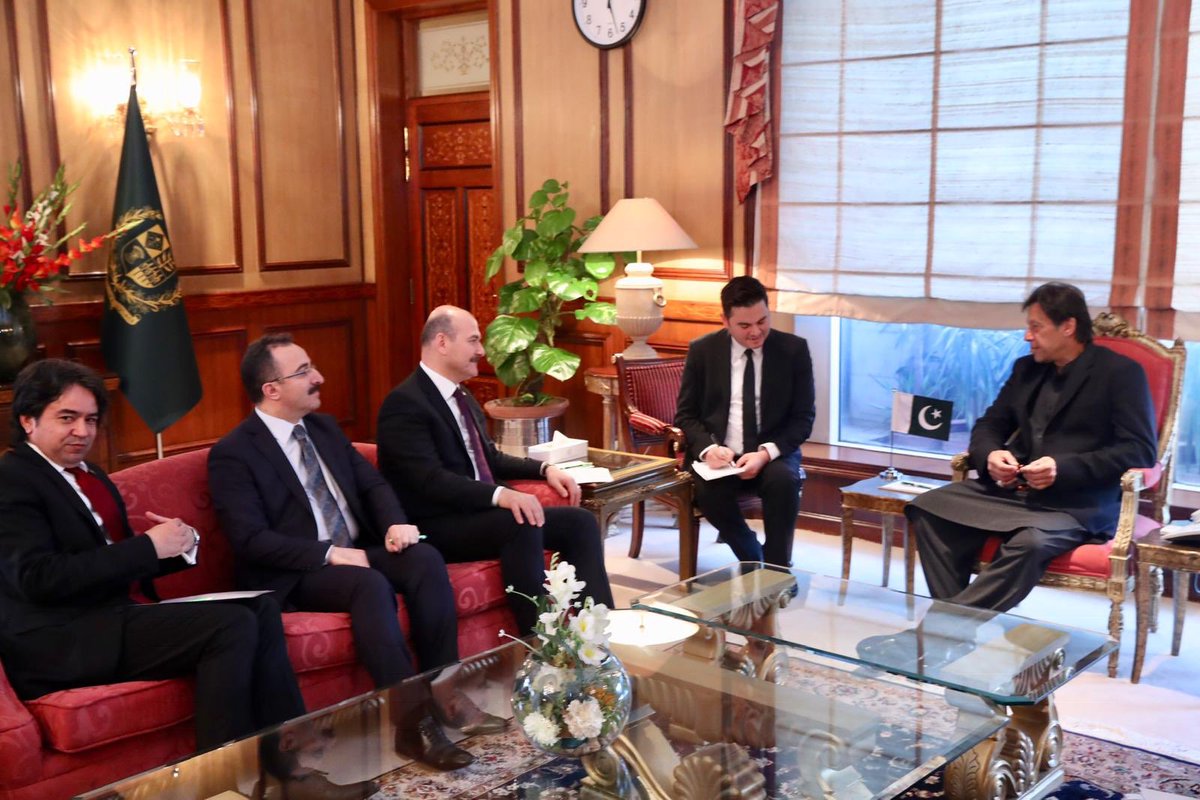
The proposal to establish such a unit was first put on the table during private talks between visiting Turkish Interior Minister Suleyman Soylu and his host, Shehryar Khan Afridi, the then-minister of state for interior, on December 17, 2018. The matter was discussed at the senior level and kept confidential from most of the staff at Islamabad’s interior ministry.
The plan was also green-lighted by Imran Khan, the then-prime minister who simultaneously held the position of interior minister, during a meeting with Soylu the same day.
The first public admission of this clandestine operation was made by Soylu during an interview on October 13, 2022 with a local TV station in Kahramanmaraş. He did not name the country but made clear he was in fact talking about Pakistan when he referred to a country that was a five or six-hour direct flight from Turkey.
Commenting on a recently approved controversial social media law that effectively criminalizes and stipulates prison sentences for criticism on social media in Turkey, Soylu recalled his talks during the visit to Islamabad. He said a Pakistani minister pulled him into a private room after talks between the delegations and asked his help with the establishment of a cyber system.

Afridi told the Turkish minister that the United States was trying to create a negative perception of Pakistan using social media and that he needed professionals who could launch a cyber army to fight off such attempts by the US and others.
Soylu said he noticed that the Pakistani minister had deliberately shied away from raising this request during the bilateral talks in front of the Turkish and Pakistani delegations, instead preferring to convey it privately in a back-room meeting.
Turkey responded positively to this request, Soylu revealed, sending five police chiefs from various departments in the Security General Directorate (Emniyet). The team worked for months in Pakistan to get the project off the ground and finally completed it. The cooperation has since continued under successive governments, with some 6,000 Pakistani police officers trained by Turkey for this and other projects.

The secret work was camouflaged under the bilateral agreement on cooperation against cybercrime when in fact it was against perceived influence operations pursued by the US, India and other foreign powers, according to sources familiar with the project.
Soylu is no ordinary Turkish interior minister. Unlike his predecessors, Soylu has gained notoriety in running troll and bot armies in cyberspace on behalf of Turkish President Recep Tayyip Erdoğan and had worked on similar covert operations even before he became interior minister in September 2016.

When he was deputy chairman of Erdoğan’s ruling Justice and Development Party (AKP) in 2014 with a research and development portfolio, Soylu secretly set up a large Twitter team to insult and target with offensive language prominent social and political figures who did not embrace the AKP’s ideals and practices. According to the parliamentary record, he controlled a 6,000-strong troll army at the time.
Since traditional outlets in print and broadcast media are almost entirely controlled by Erdoğan’s party due to unlawful seizures and the arbitrary closure of nearly 200 media outlets by the government, social media, especially YouTube and Twitter, remain the only outlets for Turks to obtain real and credible news and information about their government
Erdoğan specifically wanted to dominate the Twitter space, the last sanctuary for freedom of expression, with this troll army. A smear campaign launched by Soylu’s Twitter army attacked Erdoğan’s critics and opponents who did not toe the line with Erdoğan. The funding of the operation was discreetly provided by local governments that were run by Erdoğan’s party.
Soylu expanded his cyber army when he became interior minister and transferred many operatives he had previously employed in the private sector to the police department’s cybercrime unit even though they had no law enforcement background and no training in investigating cyber-related crimes. That was not an issue for Soylu since he wanted to turn the cyber unit into a political tool for going after opponents and critics.

There has always been civilian personnel such as programmers and software developers employed in the Cyber Crime Directorate of the Security General Directorate, but their numbers were not high. Most personnel came from a law enforcement background, and the department preferred to train and educate its own police officers to handle IT-related assignments because of the confidentiality of the investigations.
Soylu broke that tradition, purged many veteran officers from the cyber unit and employed 350 new civilian personnel to staff cybercrime, which now has only 130 police officers. What is more, in a violation of regulations and the law, he provided the cyber unit with access to sensitive intelligence collected by police intelligence, which was unprecedented. In other words 350 civilians, former trolls, gained the right to take a peek at intelligence that includes private information about tens of thousands of people including prominent figures, journalists, artists and lawmakers.
In the end, using intelligence and information as a weapon, the newly revamped cyber police department was turned into machinery to undermine in public view the opposition and smear critics and dissenters within the ruling party. Instead of investigating real crime on the internet, the teams at the cyber unit are busy hacking opponents’ emails and social media accounts, collecting private data from cell phones and computers they gained access to and using the hacked material to intimidate and at times blackmail dissidents.
The unit was blatantly abused by Soylu to launch frivolous criminal cases against social media users who express legitimate criticism of the government or journalists who publish and distribute their content on social media platforms. Many reports prepared by the cybercrime units were submitted to prosecutors in order to build sham cases against those who simply exercised their right to freedom of expression.
Now the same setup is being referred to Pakistan with a view to not only using it for domestic political goals but also for attacking foreign countries in the West as well as India, the arch enemy of Pakistan.